In this article we explore MDR vs SOC as approaches to cyber security. As cyber threats become more sophisticated, organisations are increasingly investing in services that provide continuous monitoring and response.
Two of the most common approaches are Managed Detection and Response and Security Operations Centre services. While both aim to detect and respond to cyber threats, they serve different roles within a modern security strategy.
Understanding the difference between MDR and SOC is important, particularly for organisations deciding how to improve visibility, reduce risk and respond more effectively to cyber threats.
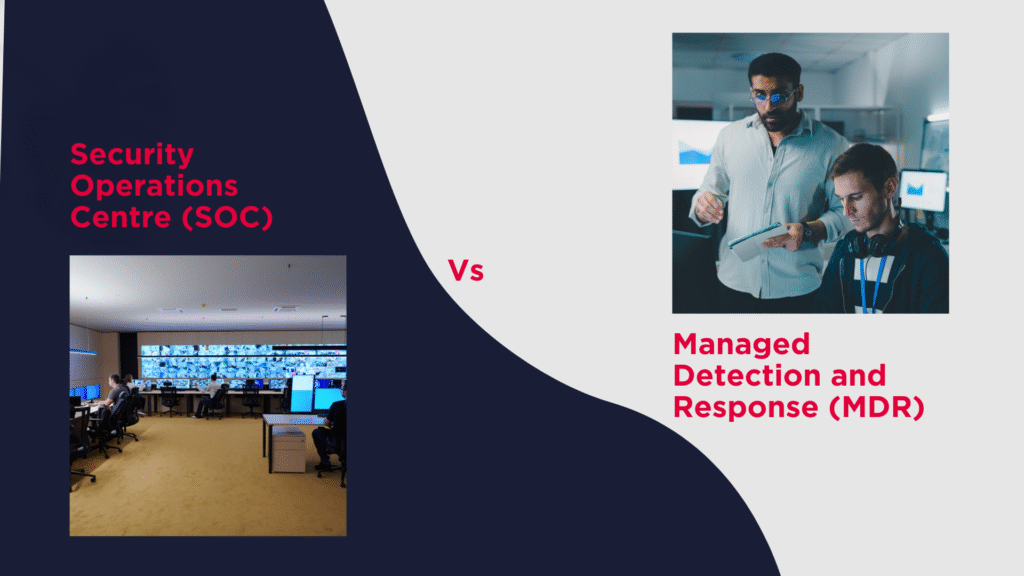
When organisations compare MDR vs SOC
Organisations typically evaluate MDR vs SOC when they are looking to improve their ability to detect and respond to cyber threats.
This often happens when:
- Endpoint protection is in place but broader visibility is limited
- Security alerts are increasing and becoming difficult to manage
- A security incident highlights gaps in monitoring
- A penetration test identifies weaknesses in detection capability
- The organisation is scaling and requires more structured security operations
At this point, the decision is not just about tools, but about how security operations should function across the organisation.
What Is MDR
Managed Detection and Response focuses on detecting and responding to threats on endpoints and user devices. MDR services monitor systems such as laptops, servers and workstations for signs of malicious activity.
Security tools analyse behaviour and generate alerts when suspicious activity is detected. Security analysts then investigate these alerts and respond to potential threats.
Typical MDR capabilities include:
- Monitoring endpoint behaviour
- Detecting malware and suspicious activity
- Investigating security alerts
- Responding to confirmed threats
MDR is particularly effective for organisations that want to strengthen protection against endpoint-based attacks without building a full security operations capability.
What Is SOC Cyber Security
SOC cyber security refers to the broader operational capability responsible for monitoring and responding to threats across an entire digital environment.
A Security Operations Centre collects and analyses security data from multiple sources including:
- Endpoints and servers
- Cloud platforms
- Network infrastructure
- Identity systems
SOC teams investigate alerts, identify potential threats and initiate response actions to contain incidents.
Unlike MDR, which focuses primarily on endpoint activity, a SOC provides visibility across the entire organisation and coordinates investigation and response processes across multiple systems.
Organisations that require comprehensive monitoring and threat investigation often implement SOC services as part of their wider cyber security strategy. This broader visibility allows organisations to detect more complex, multi-stage attacks that extend beyond a single system or device.
Key Differences Between MDR and SOC
While MDR and SOC both focus on threat detection and response, they differ in scope and operational capability.
MDR is primarily focused on endpoint protection and responding to suspicious activity on devices. SOC services monitor a much broader range of systems and provide a full security operations capability across the organisation.
MDR services are typically easier to deploy and are well suited to organisations that need improved endpoint security.
SOC services provide deeper visibility and more comprehensive threat investigation across networks, cloud platforms and identity systems.
Many organisations use MDR as part of a wider SOC capability rather than viewing the two as competing approaches.
The key difference between MDR and SOC lies in scope, visibility and operational capability.
| Feature | MDR (Managed Detection and Response) | SOC (Security Operations Centre) |
| Primary Focus | Detecting and responding to threats on endpoints and user devices | Monitoring, investigating and responding to threats across the entire IT environment |
| Coverage | Endpoints such as laptops, servers and workstations | Endpoints, networks, cloud platforms, identity systems and applications |
| Scope of Monitoring | Focused on endpoint activity and behaviour | Broad visibility across infrastructure and security systems |
| Investigation Capability | Investigates alerts generated from endpoint monitoring tools | Investigates alerts across multiple systems and correlates data from different sources |
| Response Actions | Contains threats on compromised devices or accounts | Coordinates incident response across the organisation |
| Security Visibility | Limited primarily to endpoint telemetry | Full organisational visibility across systems and infrastructure |
| Typical Users | Organisations improving endpoint protection | Organisations requiring full security operations capability |
| Relationship Between Services | Often a standalone service | Often incorporates MDR as part of a wider security operations capability |
MDR vs SOC: Which is Right for your Organisation
Choosing between MDR and SOC depends on the level of visibility and operational capability your organisation requires.
MDR may be suitable when:
- The primary concern is endpoint protection
- Internal monitoring capability is limited
- A fast, lower complexity solution is required
SOC capability becomes more important when:
- Visibility is needed across cloud, identity, network and endpoints
- Security operations need to be centralised and coordinated
- The organisation is managing a more complex environment
- There is a requirement for continuous monitoring and structured response
In many cases, organisations start with MDR and later move towards a broader SOC capability as their security requirements evolve.
When Organisations Use MDR
MDR services are often adopted by organisations that want to strengthen their endpoint protection and improve incident response capabilities.
MDR can be particularly effective when organisations:
- Lack internal security monitoring capability
- Need improved visibility into endpoint threats
- Want expert investigation of suspicious activity
- Require rapid response to confirmed incidents
For many organisations, MDR provides a valuable layer of protection without requiring the complexity of a full security operations centre. It is often the first step towards building more mature security operations.
When Organisations Need SOC Capability
As organisations grow and their digital environments become more complex, security monitoring needs to extend beyond endpoints.
SOC capability becomes increasingly valuable when organisations need:
- Continuous monitoring across networks and cloud environments
- Centralised threat detection and investigation
- Coordinated response to cyber incidents
- Deeper visibility across their infrastructure
SOC services provide a structured security operations capability that enables organisations to detect threats earlier and respond more effectively. At this stage, organisations typically require a more structured and comprehensive approach to security operations.
How MDR and SOC Work Together
MDR and SOC are not mutually exclusive. In many cases MDR forms part of a wider SOC capability.
Endpoint monitoring provided by MDR generates valuable telemetry that SOC teams can analyse alongside data from networks, cloud services and identity platforms.
By combining MDR with SOC capability, organisations benefit from both deep endpoint visibility and broader security operations monitoring across their entire environment. This combined approach provides both depth at the endpoint level and breadth across the wider environment.
Strengthening Cyber Security Operations
As cyber threats continue to evolve, organisations require effective monitoring and investigation capabilities to detect and respond to attacks quickly. MDR services provide focused endpoint protection, while SOC services deliver broader operational security capability across the entire environment.
For organisations seeking comprehensive monitoring, investigation and response capability, SOC services provide the foundation for modern cyber security operations.
MDR vs SOC FAQs
No. MDR focuses primarily on detecting and responding to threats on endpoints such as laptops and servers. A SOC provides broader monitoring and investigation across networks, cloud platforms and identity systems.
Many organisations use MDR as part of a wider SOC capability. MDR provides deep visibility into endpoint activity, while SOC services monitor the wider environment and coordinate investigation and response processes.
Neither approach is inherently better. MDR is well suited to organisations that want improved endpoint threat detection and response. SOC services provide broader monitoring and security operations capability across the organisation.
Yes. MDR capabilities are often integrated into SOC operations. Endpoint monitoring generates valuable security data that SOC teams use to detect threats and investigate potential incidents.
Moving from MDR to SOC capability
For many organisations, MDR represents an important step in improving endpoint security. However, as environments grow and threats become more complex, the need for broader visibility and coordinated response becomes more apparent.
Moving towards a SOC capability allows organisations to:
- Gain full visibility across their environment
- Improve detection of complex threats
- Reduce alert fatigue through better prioritisation
- Strengthen overall cyber resilience
This is why many organisations evolve from MDR towards a more comprehensive SOC model over time.
Summary
Both MDR and SOC services play an important role in strengthening an organisation’s cyber security operations. MDR focuses on detecting and responding to threats on endpoints such as laptops, servers and workstations, helping organisations identify suspicious activity and contain attacks quickly. SOC services provide a broader security operations capability, monitoring activity across networks, cloud platforms and identity systems to detect and investigate threats across the entire environment.
For many organisations, MDR forms part of a wider SOC capability rather than acting as a replacement for it. As security requirements evolve, the focus often shifts from endpoint protection to full visibility and coordinated security operations across the entire environment.
You may be interested in Amicis Group’s SOC Services page and our detailed post on SOC.
We’d welcome a call from you on 0333 305 5348 to discuss SOC Services